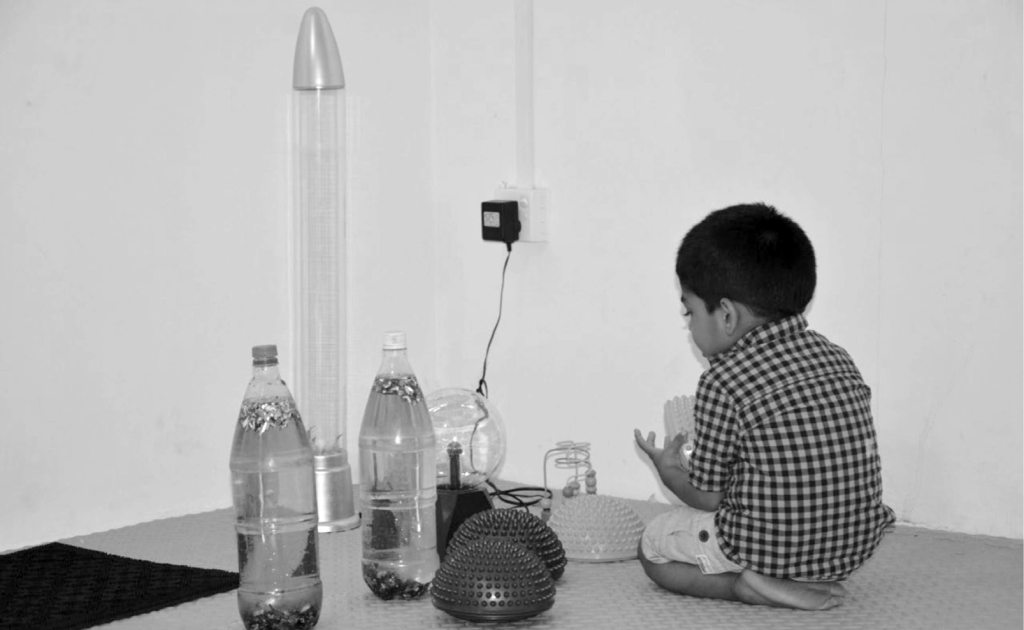
Learning is defined as the process of acquiring new knowledge, skills, behaviours, values and attitudes through experience and observation. Human learning starts at birth, or even before, when the baby is inside the womb, as a cumulative result of the ongoing interactions between parents, people and their environment. Learning is a dynamic and continuous process that involves the development of cognitive, emotional, social and physical abilities.
As we all know, newborn babies learn primarily through sensory exploration, sensory processing and emotional interaction with their mothers, fathers and carers. They learn largely about building connections between people and events and understanding the environment and the world around them through their senses, emotions, and repeated interactions.
Children with autism or its spectrum struggle with their social interaction, communication, sensory processing and the pattern of thinking and cognitive processing. As such, autism affects their natural way of learning through exploration and interaction with the environment. In particular, early learning skills like imitation, joint attention, sitting, attention, responding to commands, eye contact and name response are affected in autism, in varying severities.
The early interventions for autism and related conditions focus on building the early learning skills of those children. It is obvious that without mastering early learning skills, children with autism will struggle to achieve complex learning and education-specific
skills. Therefore, when handling individuals with autism, identifying and addressing the deficits in the prerequisite skills is crucial for successful learning. Prerequisite skills are considered as the foundational building blocks upon which other skills are built. In other words, mastering the foundational skills is necessary before progressing to more complex skills and the concepts of education.
Neglecting the prerequisite skills can significantly hinders the learning process and creates barriers for skills development. Hence, the assessments of a child with autism should also focus on the existence of prerequisite skills, and the planning of early therapies should include plans for what prerequisite skills are needed to be mastered, preferably in a hierarchical order.
For example, when a teacher tries to teach a child to learn or improve its writing skill, the teacher should make sure that the child has already developed sitting skills, copying skills, fine motor skills, listening skills, and the skills of responding to simple commands and receptive identification of letters. Without mastering those skills, the child cannot learn to write. Collectively, these skills are known as prerequisite skills for writing. Therefore, as parents and teachers, we need to train the children on the needed prerequisite skills well before starting to work on a particular target, like writing.
Opportunity creation plays a major role in skills development. Any children, in particular children with autism, should have ample opportunities not only to develop the learning skills but also to get more chances to practise those learnt skills. An optimal stimulus environment is crucial for any child’s learning process. Similarly, generalisation is another concept and a key factor in the learning process of children with autism. Therapists, teachers and the parents need to provide opportunities to generalise the skills the child achieved in different places, with different persons and in diverse settings.
There are specific strategies that can help to improve the learning outcome of children with autism. Some of those strategies are described below.
-
- Environment modification: Structured, predictable, distraction-free and the organised space with minimal sensory load will increase their focus to achieve their target.
-
- Visual aids: Many individuals with autism are visual learners. As such, they process information and learn best through visual stimuli, rather than auditory or verbal instructions. Therefore, the therapist and the educator can use visual schedules, visual cues for communication, social stories and written words for direction.
-
- Instructions: Using clear, concise language to explain each and every step of a complex task or behavioural pattern will help children process the commands easily.
-
- Reinforcement techniques: In behaviour therapy, the term reinforcement means providing a consequence (a reward or positive stimulus) after a desired behaviour, making it more likely that the behaviour will be repeated in the future. This is a positive strategy that aims to build self-esteem and confidence. Reinforcements are used to teach new skills, reduce challenging behaviours, and promote positive interactions.
-
- Breakdown the task: Dividing a task into smaller, more manageable steps is beneficial for individuals with autism, as it helps to reduce anxiety, increase focus, and make them more independent.
-
- Prepare transition: Transition from one programme to another is a known difficulty and a problem for children with autism. Therefore, planning the transition with a visual schedule, a social story, and visual timers is needed in order to reduce the anxiety, make them independent, and mitigate the challenging behaviours.
Challenging behaviours are the rules rather than the exceptions in autism. Applying behaviour therapy strategies is very effective in managing those behaviours and helping the learning process. Identifying weaknesses and strengths of a child is always important in the learning and education process. That will help the child by increasing their learning potential and help the parents, teachers and therapists by reducing their workload and hardships in handling a child. Further, applying specific techniques like reinforcement, prompting, task analysis, modelling, and chaining will accelerate the learning process.
While enhancing the learning and education processes, it is important to realise that each autistic individual is unique and has different limitations, strengths and challenges. Tailor-made learning approaches are to be developed and implemented accordingly. Apart from this individualised approach, the family-centred approaches involve families and carers in the therapeutic process and ensure that interventions are relevant to the child’s everyday life. These approaches are more suitable for naturalistic training.
Like most of the children, individuals with autism often have distinct learning styles, educational strengths, and behavioural challenges. In this context, a well-thought, well-formulated, individualised plan for the education is important in the management of autism. The child who has difficulties in going with the normal educational stream is best supported by the development and implementation of an individual educational plan (IEP).
An IEP is a personalised written plan developed for students with autism and other neurodevelopmental conditions, outlining their unique educational goals, learning needs, and the services they require. The IEP serves as a roadmap, guiding educators, parents, therapists and related service providers in delivering targeted support for people with autism. Notably, the IEP plays a pivotal role in empowering a person with autism by offering tailored support to help them reach their full potential within an educational setting.
Generally, a multidisciplinary team is involved in developing an IEP. The team consists of the child, parents, school administration, teachers from general education and special education, speech therapists, occupational therapists, behaviour therapists and physical
and other therapists. A formal IEP includes the nature of the learning difficulties, what help is to be given, who will provide the help and support, whether the child needs any equipment and, if so, what it is, what sort of methodology, programmes or materials are to be used, when, where and how often the help will be given, the nature of the support required from parents at home, medical requirements, the monitoring and review arrangements, and how it will be measured as success.
The learning and education processes do not stop with childhood. It will continue forever. As such, a close liaison with different stakeholders is the key in autism management. Together we can achieve.
Dr. Tharmila Sivapathamoorthy
Medical Officer
Mathavam